Search

red brick, yellow door

A Word to the Helpers: What She Needs Now

Helpers - Elaine Oyzon-MastShe’s headed into surgery. In the healthcare realm, she’s a patient. To you, she’s a wife, mother, daughter, friend, co-worker, or just someone you run into every now and again. No matter how you know her the compulsion to help is overwhelming, yet you feel helpless.

She’s feeling that helplessness too. She’s no longer in control of her own body. In the near-term, the daily routines she has carefully, lovingly, cultivated over a lifetime will be taken from her: kissing her husband as she heads off to work, making dinner for her family, tucking her babies into bed at night. After treatment, she’ll have to work twice as hard to cultivate new routines as she learns to live with side-effects that she can not possibly anticipate.

So she needs you. And you want to help, but you don’t know how. She’s so consumed by gratitude, guilt, and a hefty dose of propriety that she won’t ask you for help, and she certainly won’t tell you what to do. And just like those side-effects that no one warned her about, she doesn’t yet know what she needs.

The second largest determining factor for cancer survival (following relative health prior to treatment) is the patient’s support network. While love, prayers, and healing “vibes” being sent her way will certainly help her spirits, it’s not enough. The here-and-now needs to be attended to. When we break down the barriers of what is polite and proper to ask for, when we remove the presumptive attitude that she is “grateful for whatever help is given,” we can be frank about what “helping” her actually means.

She needs Money.  I don’t care how spectacular her medical insurance might be or how much money she has in the bank, cancer treatment is mind-blowingly expensive. Tens of thousands of dollars out-of-pocket expensive and it doesn’t stop when the initial treatment ends. The guilt she’ll feel over spending her kids’ college fund on rounds of pharmaceuticals is gut-wrenching. Give her money. Don’t even tell her where it came from, lest she try to refuse it. If you don’t have money to give, start a web funding campaign – I’ve seen people raise ridiculous amounts of money for less important endeavors. Have a bake sale, create a charity event, host a party with proceeds going toward her medical expenses. $20 across just half of your Facebook friends can be a huge help.

She needs Groceries. Taking her out of the day-to-day equation and adding daily doctor appointments and hours spent in bed means that ordinary life gets put on a back burner. No one realizes that the toilet paper is gone until you send your child through the house on search for a tissue while you sit on the toilet. Toilet paper, paper towels, dishwasher soap. Find out what detergent they use, what cereals the kids like to eat in the morning, what kind of milk they drink. When you buy your own groceries, pick up an extra bag of coffee and some filters, maybe a carton of orange juice and drop them off at their house. The most spectacular help you can provide right now will be the most ordinary.

She needs a Clean House. Her senses will be assaulted from all sides and she’ll be physically unable to do anything about it. Cancer treatment is messy. Vomit is inevitable, and there will be a lot of it. Her husband won’t be able to take this one on, even if he normally considers house cleaning an enjoyable hobby. Pitch in with friends and hire a housekeeper, or take on the task yourself. Once a week. This one is no joke.

She needs Meals. I know that everyone loves to sign up to bring a meal. It’s easy and it gives instant “I helped!!” gratification. Unless you know the family and their tastes, your covered dish is clogging their fridge/freezer. Her two-year-old doesn’t care how many people love your tuna casserole, he’s not gonna touch it and her husband will feel too guilty to either throw it out or to send out a list of likes/dislikes to those folks who are generous enough to supply food. For those of you who want to provide dinner, but you aren’t privy to the household table preferences, purchase a restaurant gift certificate – not a sit-down place, but someplace where they can pick up food to-go, barbecue, wings, burritos, etc. If you do make a meal, provide throw-away meal holders only. Don’t ask for your pan back. Just don’t.

She needs you to take care of her Kids. It will eat at her soul that she isn’t being the mommy she wants to be to her kids right now. Her baby will be screaming from the other side of a closed door trying to get to his momma and all she can do is put a pillow over her head to try and muffle the noise. You can’t fix this, but you can ease her pain, if but a bit. Help get her kids to school/the babysitter. Organize outings, playdates, trips to the zoo, the park, your house to bake cookies. Keep the kids entertained, occupied, and well-cuddled. Remind them just how much they are loved.

She needs you to Give Without Getting. If you find it rude that someone doesn’t send you a thank you card, don’t help. Seriously, don’t do anything. She doesn’t need to worry that you need her gratitude. She is grateful, beyond grateful. You don’t need an acknowledgement of your own kindness. If you think that not sending thank you cards is a travesty, offer to take on the job for her. Let her focus on her health while you focus on manners.

She needs you to Stick Around. A common misconception is that cancer treatment ends. Her body will never be the same, she’s expecting that. What she cannot possibly prepare for are mental and emotional struggles she’ll face for years after surgery, chemo, and radiation have taken their toll on her body. Paranoia, depression, post-traumatic stress, these are issues that she may need to work through long after she gets out of bed. Be her friend. Take her to get a pedicure. Check in with her and ask her how she is really, truly feeling. Offer up your lake house so that their family can go on a vacation together. Take care of her kids for the night so that she can go out with her husband. Her struggle hasn’t stopped, it’s just become less visible, continue to let her know she has support long after the casseroles have stopped coming.

(photo credit: Elaine Oyzon-Mast)


Motorcycles, Four-Wheelers, and Porches: Dangerous Living on London Mountain

When I was young, my uncle would take me out for rides on his motorcycle. I’d saddle up on the leather seat behind him and scream gleefully as he revved onto the asphalt of the curved country road. My arms wrapped around his waist, I’d hold on for dear life, wind whipping my hair against my face. While he might have been cruising at a mere 10 mph, in my mind he was a speed demon and I was potential roadkill. When the ride ended, the panic would subside and I’d beg for another turn, all the while my mom and grandmother sat inside around the kitchen table, chatting over a glass of iced tea (ok, it might have been a beer).

Eventually, my sisters and I got our own ride, a large, bright yellow, three-wheeled all-terrain vehicle. Not a four-wheeler….a three-wheeler. You know, the huge ATVs with two large tires in the back and only one in the front? The ones that were banned from being sold in the US for 10 years due to safety concerns? We drove one of those. Often. As children.

My sisters and I carved trails from one end of our property to the other. My older sister would sit up front, driving, with my little sister sandwiched in the middle. Making up the rear, I would death grip the cargo rack with one hand while clinging to a boom box with the other as we blared our cassette tape of the Beaches movie soundtrack (riding on a three-wheeler is apparently cool enough to make up for any questionable musical choices). Entire days of my childhood were spent on that big yellow ride. We ended up with whiplash, engine burns, and scratched corneas from flying debris. And I dare say that each one of us would jump at the chance to do it again.

We were kids of the ’80s. We rode in the back of pick-up trucks, in tractor scoops, and on rickety bicycles off makeshift ramps. We leaned our unbuckled selves out of car windows and held firecrackers in our bare hands. No protective gear of any kind was owned, let alone worn. Across three kids, and hours upon hours of joy riding on our three-wheeled speeding machine, only one trip to the emergency room was made. That time, it was my dad, not a kid, doing the driving.

Now that children of the ’80s are raising kids of our own, we look back on those memories with equal parts shock and awe. Sure, it was fun, but no helmets? That’s crazy. Not my kids. We are influenced by up-to-date information about safety and an expansive market of activity-specific safety gear. We are bombarded by media reports of tragic accidents, and we live in a culture where blaming and shaming of perceived negligent parenting is a national pastime.

In our efforts to create safety for our kids, however, we’ve anesthetized their lives. An entire generation of children don’t climb trees, cut their own food, or light matches. Their hands are sanitized after every sniffle, their bodies bathed every night. Their furniture is bolted to the walls and they are mummified in carseats until they are old enough to drive. As a by-product of today’s competition to create the smartest!most athletic!best! kids, we have turned our children into investments, portfolios that need to be managed and protected from all potential harm, both real and imagined. We have taken pain, panic, and physical exhaustion out of their childhoods and in doing so, we have unintentionally robbed them of unadulterated exhilaration. They aren’t learning their physical capabilities. They don’t know what to do when their adrenaline is pumping and panic is setting in. We have chosen not to teach our kids about their instinctual inheritance of fighting or fleeing from danger. Instead, we created a third, entirely fabricated, option: avoiding situations where danger might possibly be present.

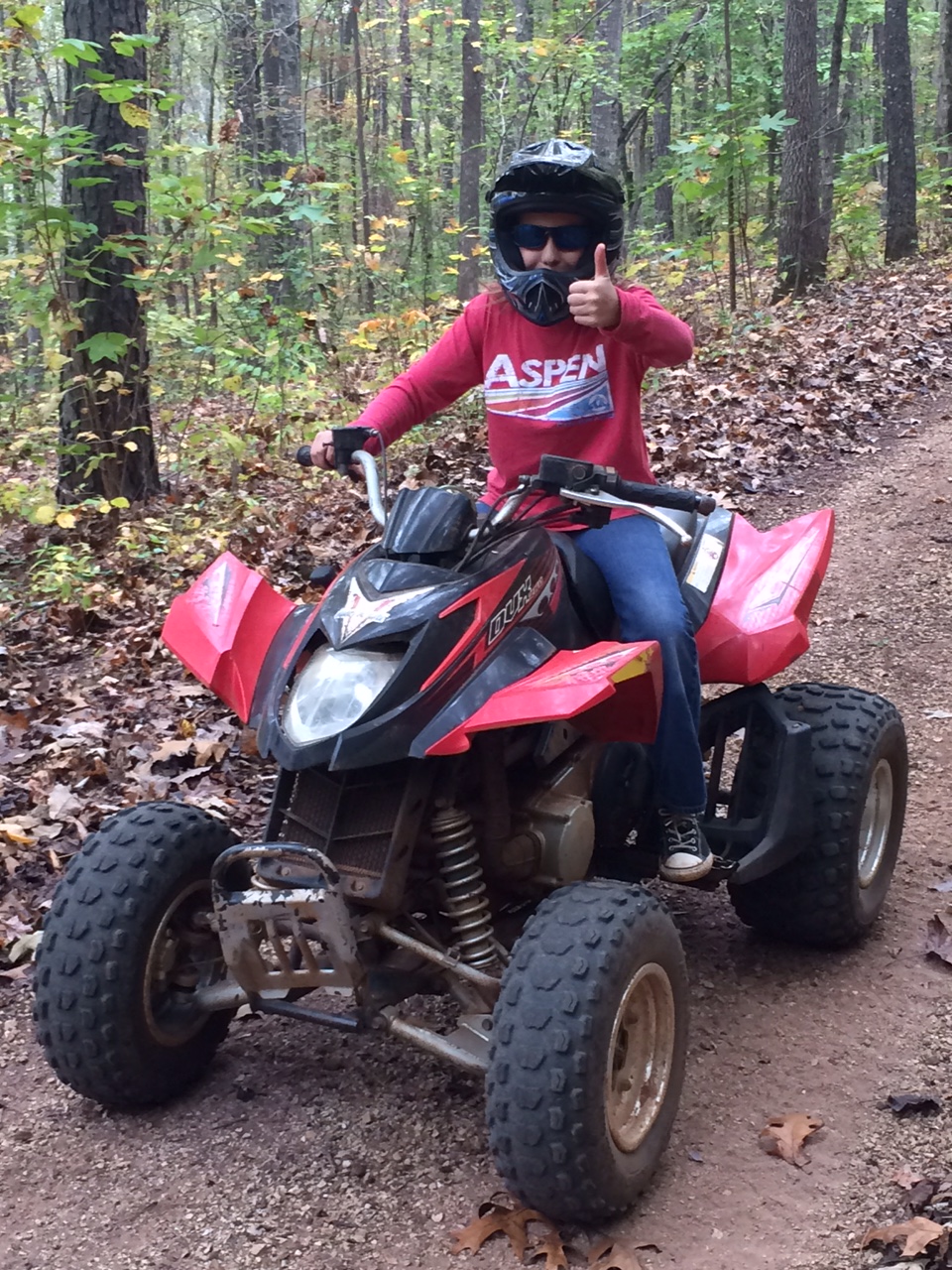
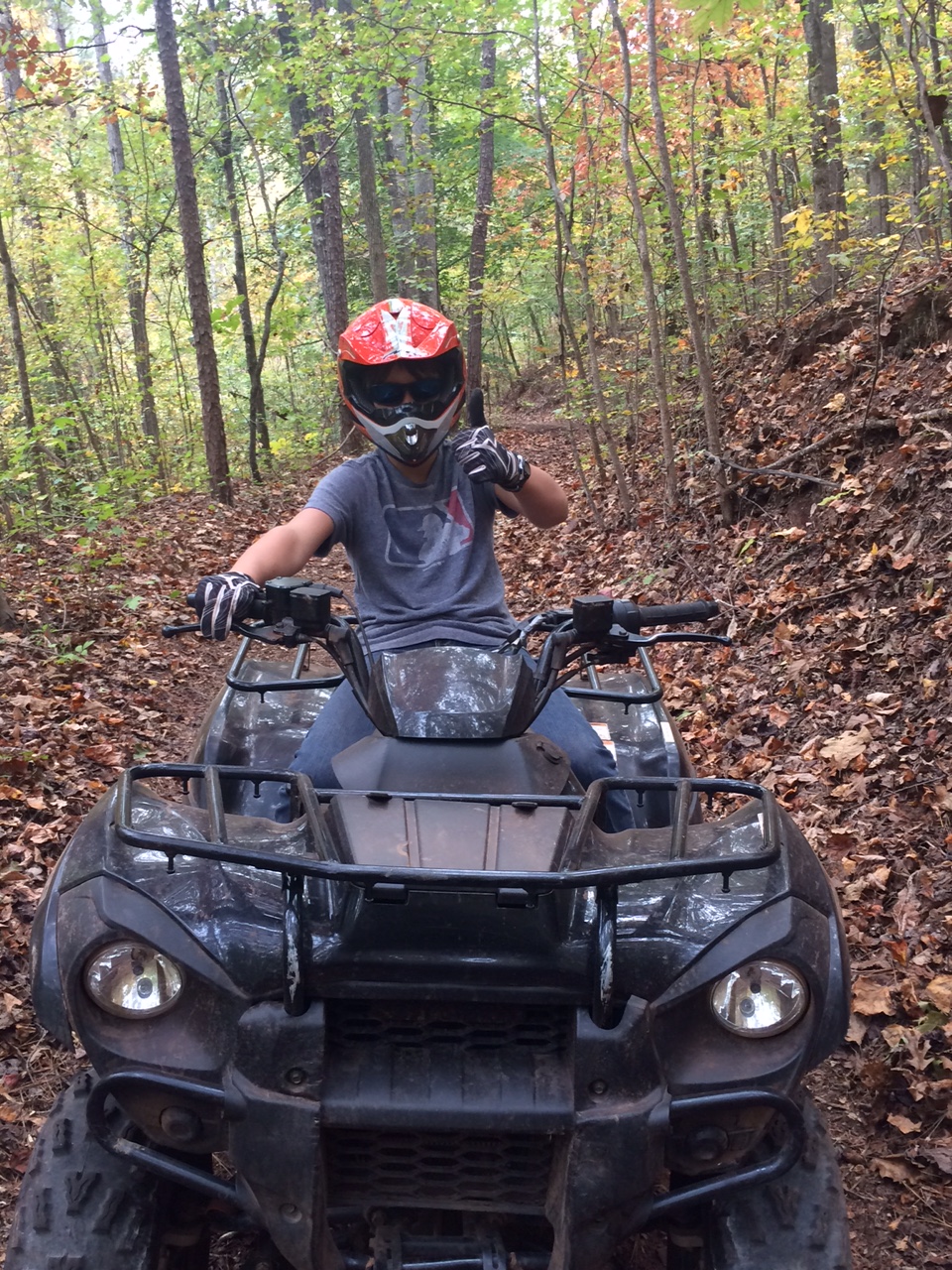
IMG_6327My oldest children, now 12 and 10, got to drive an ATV for the first time over the past weekend while we stayed at a friend’s cabin on London Mountain. My inner ’80s child giggled with glee. I could easily recall the excitement I felt as a child riding on the largest, speediest, yellowest machine ever to be set upon three wheels. As a parent, however, that excitement was tempered by every bone in my “safety first” body. My kids wore helmets, gloves, and goggles and they were supervised by a sober adult at all times.

Within just a few turns on the trails on the first day, my son flipped the four-wheeler. No one is sure exactly what happened, but for a boy whose growth spurts have outpaced his ability to maneuver his body effectively, we weren’t entirely surprised. Though he walked away without a scratch, he still received a peppering of questions over dinner that night: “Are you seeing spots? Any headaches? Does it hurt when you pee?” Apparently not to be outdone, my daughter flipped the four-wheeler the next day. I was riding right behind her and saw it happen. She didn’t so much flip the machine as she drove it into an embankment, panicked, and kept her thumb on the gas until the machine fell over on top of her. Her speed at the time, on a scale of 1 to 10 would have been -1, but the experience rattled her just the same. After we righted the ATV, she asked, “Do I have to get back on it?” I was surprised and thankful to hear myself reply, “Yep. You have to drive it. You can go as slow as you like, but you must get on. Here, let me get those leaves off your back.”IMG_6347

Despite toppling their rides, the kids were sadly disappointed to see the four-wheelers locked up as we headed back home. They had been scared – a few moments of terror, even – and they had panicked at least once on each of their runs. But during that time on those mountain trails they also felt, really felt, the full extremes of the physical world and their bodies in that world. I’m not sure that our citified, bubble-wrapped, be-helmeted children have had such an opportunity before.

I know that there are those who will read this and judge harshly, that no amount of “fun” is worth the risk and danger. But I argue that there is a point to such risk, and that it is worth it. We gave our children a chance to face real physical risks while giving them control of the outcome. They had to identify potential dangerous situations and figure out the best way to respond to it. Though the situations seemed extreme to their 12 and 10-year-old selves, my husband and I were right there, creating as safe an environment as possible. Accidents can, and will, still happen, but we can’t possibly avoid, prepare, or predict them all. When they do happen, I’d like to think that my time on that big yellow ride has helped me figure out not only how to handle panic, anxiety, and pain, but also to know the physical bliss that is possible in this world and that sometimes it is what makes life worth living.

All of this is not to say that our weekend wasn’t without any blood shed. Within two minutes of arriving on London Mountain, my three year old walked up the steps to the cabin and promptly fell off the porch. She was bleeding before I even had both feet out of the car. How do you even prepare for that? You don’t have to. Your parents took care of that in the ’80s when they taught you to breath deep, swallow your panic, and take care of business.

But maybe a little bubble wrap now and again wouldn’t be such a bad thing after all.

7 Steps for Making Your First Family Camping Trip Suck a Little Less

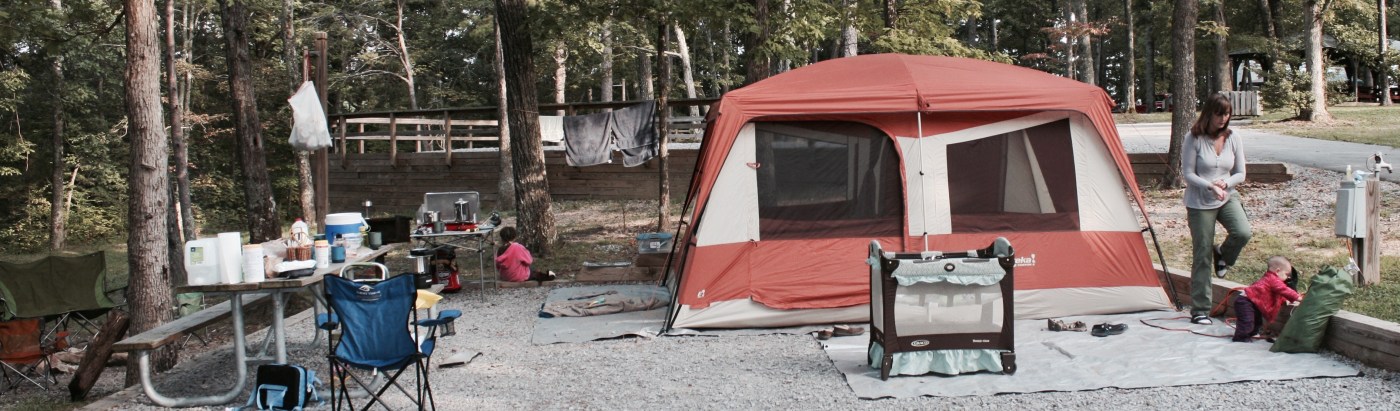
We always knew that we wanted to take our kids camping, but guilt-inducing parenting articles reminding our generation that our kids aren’t getting outside enough sealed the deal. Neither my husband nor I grew up camping, however, so we had a steep learning curve. What we’ve found is what most folks won’t tell you when they are extolling the virtues of a family camping trip: It can really suck. No, I mean really suck. Your job as a parent is to get through the suck and not let your kids see how much it sucks, so that they, too, can someday experience the suck with their own kids. Why? Because as painful as it can be, it can also be the most engaging, endearing, and memorable time you ever spend together as a family. Here’s a list of the things I wish I had known before packing up the car for the first time:

  1. Practice setting up your crap first. Never open a tent for the first time at a campsite. Just don’t. At many state parks, you can’t check into a site until late in the day. If you don’t know what the hell you are doing with all your equipment, you’ll have some pissed off kids who are wondering where their dinner is at 10:00 p.m. while you are still trying to figure out what pole goes where.
  2. Draw out a list of what you can’t live without when roughing it. I’m talking the basics. Real basic, like sleep. With four kids to wrangle at a campsite over a series of days, sleep must happen. And don’t give me that crap of the crickets and the stars lulling you to sleep under the blissfully swaying trees. Unless you regularly sleep on your hardwood floors, I would recommend an air mattress. We can fit two queen sized air mattresses and two singles into our 8-man tent. It looks a bit like a giant bouncy house, but it works.
  3. Don’t be a hero. If your idea of camping means that you emerge from the wilderness sporting a week’s worth of stubble wearing the pelts of the animals you hunted, skinned, and cooked over a roaring fire you started with two twigs and your bare hands, you might consider lowering your expectations. A lot. If it’s a first (or even a second or third) camping trip with your kids, do yourself a favor and start at your closest state park at a site that provides electricity and water. They’ll also have bathrooms. With showers. Remember that part about sleep? Now imagine that scenario with six people, a dog, and no access to showers. Not happening, folks. Not happening.
  4.  Keep your dreams of campfire culinary greatness at home. My kids know that if they see a bag of Doritos on the kitchen counter when they get home from school, we are going on a trip. Camping makes everyone hangry. For the most part, we pack healthy foods including lots of fresh fruits and veggies. Heck, we even make our own granola and trail mix, but I never regret having some crap on hand that’s quick and easy and tastes good over a fire. And sometimes that crap is refrigerator biscuits, cooked in any one of several thousand different ways. And that’s ok.
  5. Have a disaster plan. I know, a vacation shouldn’t require such a plan, but this is camping and things can go wrong. Be prepared. Talk through what you want to do if it rains. What if a kid gets hurt or stung by something that you can’t identify? What if you get split up from each other when hiking? You can’t possibly predict all that could go wrong, but you need to have an idea of how you are going to react to the most common scenarios. I have no fewer than five fully stocked first aid kits on hand when we go camping. I wish I was kidding.
  6. Prepare to entertain your kids. Read enough parenting articles related to the great outdoors and you’ll get the idea that the second your children go outside they will frolic like cute little woodland creatures, keeping themselves occupied for hours birdwatching and exploring the local flora. Hogwash. If your kids are in school, they are used to being directed by adults for 8 hours every day. Eventually, they will entertain themselves, but it might be with such wonderfully creative games as “Rock Tag” where the person who gets hit with the rock is “It.” Bring board games and cards, coloring books and crayons. Print off a camping scavenger hunt or make your own. Buy out every last glow stick Dollar General has to offer. Choose a campground that has a playground and try to pitch your tent within sight of it. You can sit back with your glass of wine while watching your kids play with all the other children whose parents are doing the exact same thing you are.
  7. Embrace the suck. Channel your inner Mary Poppins. Know going into your trip that it is going to be a lot of work, that it will probably downpour while you are trying to set up your tent, that you’ll have forgotten to pack somebody’s wubby that they just can’t possibly sleep without. Take notes on what worked and what didn’t, what gear you needed and what you wished you had. Make camping a habit. You’ll all become much more proficient at it with practice.

Accept the negative aspects of your camping adventure so that you can then shift your focus to where it needs to be – on spending uninterrupted time with your family. Work your butt off, but also play together. Tell stories. Hike the trails together, hand in hand. Your time together doesn’t last forever. Make it count.

My Midlife Crisis To-Do List

I wasn’t unhappy about turning 40. As anyone who has had cancer knows, the adage that birthdays “beat the alternative” rings true. The combination of turning 40 and my youngest child going off to preschool (thus giving me several hours each day without child-rearing responsibilities), however, has caused me to reflect upon where I am in life and where I still want to go. Some folks emerge into their 40s with expensive cars, affairs, and a dive bomb into a new career. I find myself hitting the midlife arena armed with quite a bit less drama. I happen to like my mini-van, as well as my husband, and I couldn’t shake my kids off my tail if I tried.

So how does a hyper-practical stay-at-home mom of 4 who still has grandiose delusions of doing something daring with her life (but not sure yet what) go through a midlife crisis? I make a list, of course. Consider these my to-dos for 40:

  1. Say Yes. Most parents will say that they have the opposite problem – that they say yes too often and as a result they are stressed out and overwhelmed. I don’t have that problem. I say no. A lot. In the not-so-great movie Yes Man, Jim Carrey is encouraged to say yes to every question that comes his way. Hilarity ensues, as does, eventually, self-fulfillment. Since my life isn’t a Hollywood movie (ain’t nobody gonna wanna see that one), I don’t think it is necessary to go off the deep end to still see some positive results from opening myself up to new opportunities.
  2. Find a passion (or two). It’s a cliche, I know, but I spent my 30s waist-deep in the trenches of being a full-time caretaker for my family. If I had interests before I had kids, I don’t even remember them anymore. Time to figure out what gets me grooving.
  3. Get nerdy. I got my first email account my sophomore year in college. I had to submit a request to the Computer Sciences department and pay a user fee of $15. I was on the cutting edge. Now, my kids talk about MineCraft for what seems like hours on end as my eyes glaze over and my brain turns to Jello. My three year old already navigates the iPad as though she had access to the Apple Genius Bar in the womb. At the current rate of technological advances, I’ll need my children to show me how to turn on my own shower by the time I’m 50. I’ve never been a technology junkie, but I’m not going to become a relic. If my kids are going to look down on me one day, it’s going to be because I am too old to remember their names as they are changing my diaper and not just because I need their help logging on to my Pinterest account.
  4. Travel. I don’t know anyone who wouldn’t add this to their list of “what I’d like to do more of.” I’ve only been out of the country twice in the last 40 years and I count states that I have flown into to try and make that travel list look more impressive. I have no budget for travel this year, and the thought of dragging 4 kids along with me is mind-numbing, but I’m determined. I will see new places, dammit!
  5. Write. I was a Creative Writing major in college who went on to work first in business middle management, then in child rearing. Over time, my creative juices continued to ebb until all I was left with were some computer disks that predate the new millennia that contain writing samples that I can’t even figure out how to access. I’ve missed using that part of myself, but I have found that the act of writing is a lot like exercising. When it’s a regular habit, it can, at times, seem effortless. You might even find a healthy dose of exhilaration in it. Take a long hiatus (lets say 15 years, more or less), however, and the restart can be a bitterly painful experience.

So that’s my list. Five items, one year. Ambitious? Sure, but last I checked, there aren’t any do-overs.

The Least Dramatic Cancer Experience in the History of Cancer

My father is a cancer survivor. I do not use the term lightly – he had more than one brush with death during his treatment. Now, several years after being declared cancer-free, his life is still impacted by the disease. It has been an ugly, tear-filled, dramatic experience for my father and our entire family.

In contrast, my entire cancer experience from diagnosis to the “cancer free” designation took less time and heartache than most kitchen renovations.

It doesn’t feel appropriate to say I’m lucky (“lucky” and “getting cancer” just don’t jive), but fortunately for me, my cancer was entirely treatable with an impressively high five-year survivor rate of 95%. That’s not to say that there weren’t some dramatic components to my cancer experience. I was only 37 when I was diagnosed. I had four children, the youngest of which was only 18 months old. I was diagnosed at stage IV with a rare cancer that usually only preyed upon grizzled old men who spent the majority of their lives inhaling nicotine and whisky. Treatment was brutal. My throat was burned to a crisp by radiation and pain meds made me vomit. I lost weight. I lost hair.

And then it was over.

Really. Just like that.

I went for my first run (ok, jog)  just three weeks after my last dosage of radiation. Less than five months after diagnosis, I was given my cancer free card. Two years later, memories of my treatment are similar to those of giving birth. I have distinct recollections of pain and suffering, but no real association to it. Those friends and family who were witnesses to my treatment and recovery remarked on my strength, courage, and determination. For the first time in my life I was told that I was inspiring. I was a survivor.

Only I wasn’t. There is probably some statistic out there that could claim that I was more likely to die in a car crash within spitting distance to my house than I was to die of tonsil cancer at 37 in an otherwise amazingly healthy body. I’m not a survivor for being cancer-free any more than I am because I managed to get my minivan home in one piece. Rather than survive cancer as so many can rightly claim to have done, I endured it.

Enduring is so not dramatic. There are no ribbons to wear for tonsil cancer, no three day walks. There is only endurance, but that’s the point. Cancer isn’t always a death sentence, though we all treat it like it is. While that attitude can be helpful when sympathetic family and friends come out in supportive droves, it can also lead the person with cancer to believe that to go from diagnosis to cancer-free is some miraculous, dramatic journey where only the strongest, toughest souls will survive. Sometimes cancer isn’t a life-or-death war that needs to be fought. Sometimes it’s just a really crappy illness that you have to get through.

I believe that there is a time that comes for all cancer victims when we need to decide whether or not the disease defines who we are. The drama that surrounds cancer can be a heady drug – it can make us feel very special to hear others tell us how strong, courageous, and inspirational we are. It can make us lonely to watch the well of sympathy run dry as friends and family return to making meals for their own tables. Getting back to normalcy after treatment can be physically exhausting.

Some, like my father, will always be defined, in some part, by his cancer experience. His physical scars serve as ever-present reminders of his sickness. For those of us who aren’t like my father, we should embrace our good fortune and work to help others take the drama out of their cancer diagnosis. No one wanted to tell me, “No, really, you are going to be FINE.”  What if I was one of the 5% with tonsil cancer who wasn’t fine? Would I spend my eternity rising from the grave to whisper into the ears of my well-intentioned friend “You were wrong. You were wrooooooooong!”?

Maybe. But mostly I think that taking some of the drama away from the diagnosis would have dissipated much of my anxiety. I might have shed a few less tears, spent less time thinking that I was going to die. My experience with cancer wasn’t a freakish anomaly. There are others like me out there. We aren’t superheroes, we experienced no miracles, we performed no magic. We just happened to slog through a particularly intense shit storm, after which we dried ourselves off and moved on.

Cue dramatic music. We endured.

Beware of Campsite 529

Murphey’s Law of family travel: No matter how practical, methodical, prepared, and organized you are, be prepared for a zinger that will cause your head to ache, your back to break, and your soul to whimper, if just a little.

Campsite 529 was absolutely perfect in every aspect. Flat, not too far from the bathrooms, within sight of the playground and the camp host.

Perfect.

Until it got dark.

No, that wasn’t the moment that some deranged ax murderer started stalking the campsite. Such a menace would have never stood a chance near Campsite 529. What we failed to notice during the scenic, beautifully sun-lit day was an extremely large, extremely bright lamppost towering directly over our sweet home away from home. We waited, convinced that an automatic timer would switch the beacon off as the night wore on. As the hours ticked away, however, the phosphorescent sentry continued to glow, burning its yellow haze into our corneas.

By ten o’clock, the older children were tearfully bemoaning the ineffectiveness of the 50 glow sticks that they insisted on breaking open the minute we set up camp. Our tent had become a front row seat at an insect rock concert, their seemingly gigantic skeletons plinking loudly against the hard plastic shell of the world’s biggest bug lamp. Worst of all, nothing could convince the baby that, though it looked like it was noon and therefore time to play, it was actually several hours past her (very, very, necessary) bedtime.

Whether setting up or taking down, campsite work is arduous. The thought of moving our carefully placed tent and our ten million other belongings to a new campsite filled us with dread. We listed the pros and cons of such a move. We hemmed…we hawed… As we attempted to convince the baby to sleep with yet another round of off-key lullabies, my husband looked at me, the red veins in his eyes clearly visible, and offered the dreaded “I’ll do whatever you want to do.”

I could bear it no longer. The thought of spending another night cocooned in the gruesome haze was too onerous to bear. We had to move.

Once my watch told me that the sun had risen, I searched for a new home. I found just one open site. It was on the opposite side of the campground, it was not flat, it was far away from the playground, and it was even further away from the bathrooms. The kicker: between it and the big beacon of light there were trees. Lots and lots of leaf-filled, light shielding trees.

I could feel the husband’s unspoken grumbles as I walked him to this less than idyllic location. Somehow, I channelled Mary Poppins from deep within my psyche. With “A Spoonful of Sugar” ringing in my ears, I was playful, I was entertaining, I was helpful. I was even NICE. Like, to everyone. And they ate it up.

We carelessly tossed our gear into the van. The kids became miniature sherpas, canvassing bags, clothing, towels, and sacks of food across the campground. My husband shoved the half-broken-down tent in the back of the van and drove it, back door open, to our new campsite. The entire process was complete in 30 minutes. A campsite establishment record. We grilled up a lazy man’s hot dog dinner that night, shook up another 50 glow sticks and waited. It got dark. Then, it got darker. The light from across the campground at Campsite 529 could not make it through the tree line to assault our tent. It got so dark we needed to use both our lanterns just to get the kids into their pajamas.

By the time my husband and I fell asleep that night, I couldn’t see my hands in front of my face. I groped blindly in the dark for the bed next to mine and touched upon the best possible payoff of changing plans on the fly:  the baby, deliciously, completely, and utterly, asleep.

Don’t Pray for Me, Argentina

[Context Commentary: In September of 2013, I was diagnosed with Stage 4 Tonsil Cancer. I was pretty pissed. While I wrote this musing in anger, the only part I disagree with today is that I might live to braid my daughter’s hair. At three and a half, Ella still looks like a freshly-shorn Army recruit. I might miss out on that one.]

“I know you don’t believe in it, but I’ll be praying for you.”

I’m about to commit the ultimate taboo of telling someone else really shitty news. I’m going to tell you not to pray for me. Let me repeat that really slowly so that it sinks in completely: I DO NOT WANT ANYONE (this means you, your church, your grandma, and your scout troop) TO PRAY FOR ME. Though I put this request (command) in all caps, please don’t use an angry voice to read it. It’s more of an “Enough already, I really don’t want another brussel sprout on my plate” kind of tone. Rolling your eyes while saying it will get you closer to my intent. Telling folks you are very sick seems an opportune time for many to tell you all the good things about their god. Telling me that you are going to pray to your god for me is akin to “Oh, did you know I can do magic?”

I am a pragmatist, a realist, one of the most practical minded people you’ll ever meet. My husband not-so-jokingly calls me “dream killer” around the house as he and my children create elaborate schemes and compilations and I listen patiently before intoning “Yes, but…”. This isn’t sad and doesn’t mean that I lack vision, it’s just that this is the way I am hardwired. You are going to tell me your one step plan and I am going to break that plan down into 1,366,999 other steps that you didn’t even realize could possibly be there. Yes, it can be annoying. It can also be simply brilliant.

Where my pragmatic nature leads me is to understand and accept that prayer simply doesn’t work. If you absolutely must believe then please, prove me wrong.

Do it.

Right now.

Make it work.

Go ahead, I could use a win.

Prayer, in the sense that you ask for something and it’s given to you, is easily testable. Please pray for my cancer to go away, right now, before my body is racked by radiation and chemotherapy. Before my children have to see me as a walking skeleton who needs a feeding tube for sustenance. Before my husband has to manage work, house, children, and a sick wife for weeks on end by himself.

Yep. That’s what I thought. Tumor is still there. Shocking.

Now, I’m completely familiar with what we say when prayer doesn’t work. I grew up Catholic, spent many years in Catholic schools, including two colleges that required theology courses for graduation. That’s not how prayer works, I’ve been told over and over again. God is mysterious and he “has a plan.” He only gives us what we can handle and he helps those who help themselves. He will make sure that we have what we need rather than just handing over what we think we want.

Wait for it, I’m about to hit taboo #2….if any of the above is true, your god is an asshole. Bonafide. If you can justify your god allowing a mom of four small kids suffering from cancer while child rapists live to be 80 without issue, you are an asshole too.

While I currently have no more evidence that your god exists than I do fairies, Santa Claus, Zeus, Vishnu, or the Loch Ness Monster, I do accept that with proof, the burden of “belief” disappears. Worship of said entity, however, is something that I just can’t do. Given what he allows to happen, what that big boring black book gives him credit for, I have to tell you, I think he’s a real dick. I realize that in breaking these taboos I am offending you. I’m supposed to remember that: 1. your heart is in the right place, 2. you are only trying to help, 3. prayer certainly couldn’t hurt the situation.

Taboo #3: I find your prayers offensive. By saying you will pray for me, especially when you know that I don’t happen to believe in the power of prayer, you are telling me that you do not respect my beliefs. To know that you’ll make excuses if I don’t get better rather than admit that your prayers didn’t work makes me want to punch you. To think of people sitting around thinking, hoping, and wishing, instead of taking action irks the hell out of me. To consider that if I don’t get better you’ll attribute it to “god’s plan” and that will be ok with you, makes me more than a little nauseous. And prayer does hurt. It gives people a sense that they are helping and therefore gives them justification for doing absolutely not one other thing that actually does help. Prayer won’t mow our lawn tomorrow, or get me to radiation therapy every day for six weeks. Prayer won’t make sure that my kids get outside on cool fall days when I can’t get out of bed. Prayer won’t pay our medical bills.

I believe that my doctors will cure me of cancer. I believe that their task is 95% of the fight and that while I only need to fight the other 5%, it will be the harder fight. I believe in the power of my mother to get shit done to pick up the pieces I can’t pick up. I believe that by surviving cancer himself, my dad has paved the way for my own fight. I believe that my friends and family, no matter where they are, will come to our aid as we plug through the next few months.

I believe that my husband is an absolute bad ass.

I believe that I will live long enough to braid Ella’s hair.

These are the beliefs that I hold on to. If you are going to come in to my life at this time, please respect my beliefs and keep yours on the other side of the door. If you really want to know what you can do for me, let’s start with that.

The Art of ReInvention

The last time I wrote a resume, people were still stuffing their basements with apocalypse supplies in preparation for the anticipated Y2K disaster. That resume landed me a great job with a great company where I worked for many years. I made friends, travelled, earned promotions and made lots of money. The stuff career dreams are made of.

Then I had babies.

I tried, after the first baby, to maintain my prenatal workload despite the introduction of nursing bras and zero sleep. Even after the second baby I kept going, maintaining some sense of balance by  reducing my work hours. By the third pregnancy (yes, we know what causes it, and yes, it was planned), my career had completely taken a back seat to my family. I opted out of the workforce. I was tired of being jealous of the nanny, tired of feeling like I was doing a crappy job at work, and tired of feeling like I was doing an even crappier job at home. I was just tired.

I’ve now been a stay-at-home parent for six years. It’s been a lovely six years and I actually (honestly) have no regrets. I’ve been a better parent and a better – I’ll say it – person since I’ve been at home with my kids. We’ve had one more kid since then (yep, that one was planned too) and added a dog. My staying home to take care of our family full-time was the right decision, without question.

Then came this, a game changer: My youngest child started preschool. For the first time in the six years that I have been a stay-at-home parent, I don’t have a child to stay at home with.

For those of you who don’t have kids, let me make one thing perfectly clear. “What are you going to do all day?” isn’t the right question. My family eats at home – I cook. One income doesn’t afford us a maid – I clean. Six people dirty a lot of clothes – I launder (oh, so much laundry). Schools need tons of support – I volunteer. I grocery shop, fix broken things, help with homework. My day isn’t lacking for “things” to do.

The right question is, “What do you want to do all day?” For six years, I’ve devoted myself solely to parent-y, household-y activities. While I know that none of those things are going to disappear now that all my children are in school, I don’t want them to command my focus. Yes, without children at home it might, just might, be possible for me to be caught up with laundry, at least most of the time. Hell, I bet I could even learn to master the most dreaded of household chores: fitted-sheet-folding. But I don’t want to. (Irresistible aside: does it really matter if your sheets are rolled in a ball? have you ever had someone come over and look in your linen closet and remark on the mess that’s there? have you ever had someone come over and look in your linen closet?). I’m not saying that running a household isn’t important, just that I don’t want it to be all that important to me.

The beauty of my situation is that my family isn’t dependent upon my income generation (although more money would be really, really nice to have). Without dollars clogging up the equation, I feel no pressure to walk a path that isn’t ideal. For now, I get to ask the question “What do I want to do now?” and enjoy the pursuit of uncovering the answer.

Create a free website or blog at WordPress.com.

Up ↑